
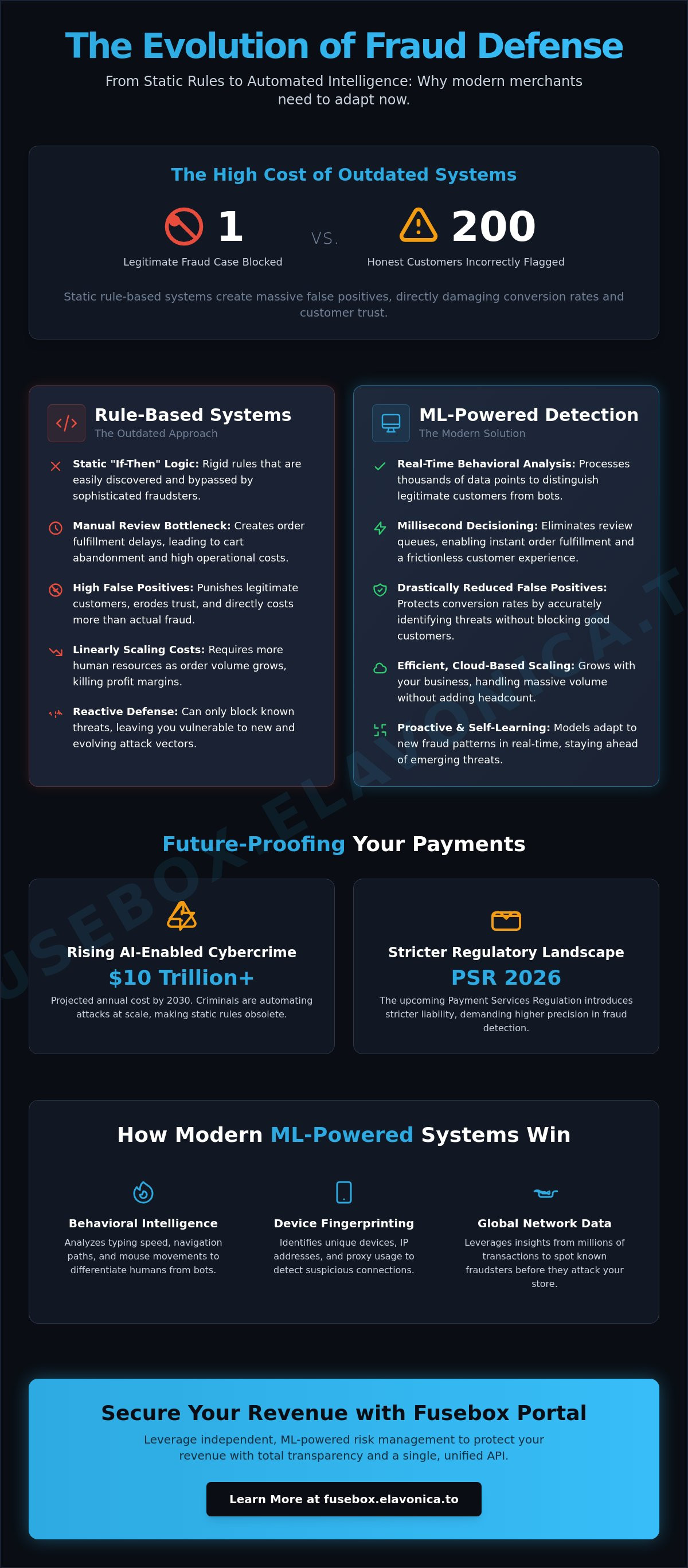
Industry benchmarks reveal a staggering inefficiency: for every legitimate fraud case blocked by a rule-based system, up to 200 honest customers are incorrectly flagged. That's a direct hit to your conversion rate. With AI-enabled cybercrime projected to exceed $10 trillion annually by 2030, static rules are a liability. Modern automated fraud detection is the essential engine for merchant liquidity. It replaces guesswork with real-time behavioral analysis to stop sophisticated threats without stalling your growth.
You recognize that manual reviews are a bottleneck for order fulfillment and a drain on resources. The 2026 regulatory landscape, specifically the upcoming Payment Services Regulation (PSR), introduces stricter liability frameworks that demand higher precision. This comparison details how automated systems protect your revenue and streamline global payments. We examine the shift from credential-based security to continuous behavioral intelligence, providing a clear path to lower operational overhead and faster transaction processing.
Key Takeaways
- Modernize your defense by moving from static, rule-based filters to adaptive machine learning that processes thousands of real-time data points.
- Eliminate manual review bottlenecks to achieve millisecond decisioning and significantly faster order fulfillment.
- Protect your conversion rates by drastically reducing false positives that often cost merchants more than actual fraud.
- Integrate automated fraud detection directly into your payment stack via a unified API to ensure security is a core component of your infrastructure.
- Leverage Fusebox Portal’s independent, ML-powered risk management to secure your revenue with total transparency and no-nonsense authority.
The Evolution of Fraud Defense: Why Manual Methods Fail in 2026
Traditional fraud defense is failing US merchants. It relies on rigid "if-then" rules created by human analysts. These systems are reactive. They wait for a threat to occur, then try to block it next time. In 2026, this approach is obsolete. Criminals now use generative AI to create synthetic identities and automate attacks at scale. They bypass simple filters with ease. Automated fraud detection provides the proactive intelligence needed to stay ahead. It replaces static rules with dynamic models that learn from every transaction.
The High Cost of Human Intervention
Manual review is a profit killer. It creates a massive bottleneck in your fulfillment pipeline. Customers expect instant confirmation. A manual queue creates delays that lead to cart abandonment and lower merchant credibility. The financial drain is significant. You pay for wages, training, and management of large review teams. These costs scale linearly with your order volume. Manual reviews are also subjective. Inconsistency leads to false positives and lost revenue. Scaling your business requires a solution that grows without adding headcount. Speed is your competitive advantage. Don't let human intervention take it away.
Adaptive Threats vs. Static Rules
Static rules are predictable. Fraudsters use this predictability to their advantage. They test "hard" thresholds to find the exact point where a transaction is flagged. If you block all orders over $500, they simply run multiple $499 transactions. This "all-green" fraud looks legitimate to a rule-based system. Exploring artificial intelligence in fraud detection reveals how these systems identify subtle anomalies. Instead of just checking if a credit card number is valid, automated fraud detection analyzes behavioral patterns. It looks at typing speed, navigation paths, and device fingerprints. It distinguishes between a loyal customer and a bot in milliseconds. This move from credential checking to behavioral intelligence is essential. It protects your revenue without punishing your best customers.
Understanding the Tech: Rule-Based Systems vs. ML-Powered Detection
Rule-based systems are frozen in time. They rely on "if-then" logic defined by human experience. If a fraudster changes their method, the rule breaks. This creates a massive vulnerability in a high-velocity market. Automated fraud detection operates differently. It processes thousands of data points in real-time to identify anomalies that humans can't see. It doesn't just look for "bad" transactions. It learns from "good" ones to build a baseline of legitimate behavior. This creates a living defense system that evolves with your business.
How Machine Learning Models "Think"
ML models use feature engineering to analyze complex variables. They evaluate device fingerprints, transaction velocity, and geolocation simultaneously. They look for patterns in IP addresses and proxy usage that manual reviews miss. Research in Data Mining-based Fraud Detection Research highlights how these systems categorize diverse methods to improve accuracy. ML-powered detection is a self-optimizing security layer that gets smarter with every transaction. Confirmed chargebacks create a feedback loop. This trains the algorithm to recognize evolving attack vectors. The result is a system that predicts fraud before it happens.
Hybrid Approaches: The Best of Both Worlds
Some business niches require specific constraints. A hybrid approach combines global machine learning patterns with merchant-specific rules. You might need a hard limit on specific high-risk regions or product categories. Risk scoring assigns a numerical value to every transaction based on its probability of fraud. High-velocity checks prevent carding attacks. Transactions with low scores pass instantly. High-risk scores trigger additional authentication or a targeted review. Global data patterns allow the system to recognize a fraudster on your site even if they've never visited you before. If they were flagged on another network, the system already knows to block them.
This balance ensures maximum protection without sacrificing speed. It allows you to scale into new markets with confidence. Unified platforms integrate these sophisticated models directly into your checkout process. This removes the friction of third-party redirects. You gain total visibility into your risk profile without slowing down your customers. If you want to see how integrated security improves your bottom line, explore our Fraud & Risk solutions today.
AI Decisioning vs. Manual Review: Speed, Accuracy, and False Positives
Manual review is a relic. It forces a binary choice on complex, high-velocity data. Modern automated fraud detection provides a confidence score instead. This numerical value allows for nuanced decisioning. High-confidence transactions pass instantly. Low-confidence ones are blocked. Mid-range scores can be routed for a quick secondary check. This precision reduces manual workload by over 80%. Your staff can stop policing transactions and start focusing on market expansion. Speed is the new currency. AI decisioning happens in milliseconds. It ensures your checkout remains frictionless.
The Silent Killer: False Declines
False positives are expensive. They cost merchants more than actual fraud in many high-volume sectors. Industry research suggests that 33% of shoppers never return to a brand after a false decline. It's a total loss of lifetime value. Traditional filters often flag "traveling customers" as "stolen cards" because they don't understand context. Understanding how AI is used in financial fraud detection reveals why it's superior at distinguishing between these scenarios. It looks at historical behavior and device consistency. This protects your fraud-to-sales ratio. You maximize profitability by approving legitimate orders that manual systems would reject.
Real-Time Monitoring and Instant Payouts
Security and cash flow are linked. Automated trust is the foundation for instant payouts to bank accounts. If your risk management is slow, your capital is trapped. Real-time monitoring provides the confidence to move money faster. This is critical during high-traffic events like Black Friday or seasonal sales peaks. Manual teams can't keep up with 10x spikes in volume. Automated fraud detection scales instantly. It handles thousands of simultaneous checks without latency. This speed also improves international transaction success rates. Global customers expect immediate results. If your security layer adds seconds of delay, you lose the sale. Integrated AI removes that risk. It protects your revenue while accelerating your growth.
Key Requirements for an Effective Automated Fraud Detection Stack
Selecting a fraud solution is an infrastructure decision, not just a software purchase. Effective automated fraud detection requires a stack that balances deep data analysis with operational simplicity. It must protect your revenue without adding technical debt. A fragmented system creates blind spots that modern criminals exploit. Your defense must be as integrated as your checkout process. Look for a solution that prioritizes data density, customizability, and global reach.
The Importance of a Single API Integration
Data silos are security risks. When fraud tools are separate from your payment gateway, information gets lost in transit. A unified API ensures that automated fraud detection is an organic part of your online payment processing. This single-point integration eliminates the need for multiple third-party scripts that slow down page loads. It simplifies the developer experience by providing a single source of truth for every transaction. Speed-to-market is a major benefit. You can deploy a comprehensive defense in hours, not weeks. A unified gateway captures the full context of a payment, from the initial click to the final settlement.
Rich data sources are the fuel for these systems. Your stack must analyze more than just credit card numbers. It should evaluate device fingerprints, network integrity, and user behavior in real-time. Every business has a unique risk appetite. A high-volume digital goods merchant may accept higher risk for faster throughput, while a luxury retailer requires stricter verification. Customizable risk thresholds allow you to tune the system to your specific needs. This flexibility prevents the "hard" thresholds that lead to the false declines discussed in previous sections.
Advanced Reporting and Reconciliation
Transparency is a requirement for modern compliance. Under the 2026 Payment Services Regulation (PSR), merchants face stricter liability frameworks. You must know exactly why a transaction was flagged or blocked. A centralized dashboard provides this clarity. It aggregates data across all transaction types and regions. This reporting doesn't just stop fraud; it identifies growth opportunities. You can see which markets have the highest trust scores and expand accordingly. Automating the reconciliation of safe versus disputed funds protects your cash flow. It ensures your accounting stays accurate even during high-velocity sales events. Integrated reporting turns raw data into actionable business intelligence.
Global coverage is the final piece of the stack. Your defense must be as effective in cross-border transactions as it is in local ones. Real-time monitoring across different jurisdictions ensures consistent protection as you scale. If you are ready to eliminate integration friction and secure your global revenue, explore Fusebox Portal’s Fraud & Risk infrastructure.
Securing Your Revenue with Elavon Fusebox’s Integrated Risk Management
Elavon Fusebox delivers automated fraud detection as a core component of your financial infrastructure. It isn't a bolt-on service; it's the engine that powers your transaction security. Our machine learning models process thousands of data points out of the box. You don't need to build complex logic or hire teams of analysts to stay protected. We provide a modern, authoritative solution that scales with your ambition. By integrating security directly into the payment flow, we eliminate the data silos that traditional methods create.
The Elavon Fusebox Advantage: Built-In Intelligence
Our machine learning models protect cards, ACH, and digital wallets simultaneously. This cross-method intelligence identifies patterns that siloed systems miss. We are an independent platform. This independence is a critical advantage for merchants. It ensures our risk protocols are transparent and focused entirely on your success. You aren't tied to a specific bank's rigid or outdated rules. You gain a partner that prioritizes your conversion rates and protects your reputation. Managing this complexity is straightforward through our intuitive dashboard. It provides a single, clear view of your entire risk landscape. You see the logic behind every confidence score, which turns raw data into actionable business intelligence. Our straightforward approach removes the fluff and delivers results.
Next Steps: From Integration to Instant Payouts
Moving to a high-performance stack is simple. The Elavon Fusebox API allows you to get started today. You can accept over 100 payment methods with a single integration. Each one benefits from the same unified protection. This global reach is essential for 2026 merchants. You can expand into new regions without fearing local fraud spikes or synthetic identity attacks. Our system handles the technical complexity of cross-border security automatically. This allows you to focus on market growth rather than policing transactions. Secure risk management leads directly to faster capital access. Once your trust baseline is established, you can leverage features like instant payouts to keep your business moving at the speed of modern commerce. Don't let manual reviews hold your revenue hostage. Secure your transactions with Elavon Fusebox and experience the efficiency of modern risk management.
Future-Proof Your Revenue with Intelligent Security
Legacy manual reviews are a liability that modern commerce can't afford. As attack vectors become more sophisticated, relying on static rules or human oversight creates friction that drives customers toward competitors. True automated fraud detection replaces these vulnerabilities with a self-optimizing security layer. It ensures that every transaction is evaluated with millisecond precision. This protects your capital without sacrificing the customer experience. This shift is essential for maintaining operational speed and scaling into new global markets.
Elavon Fusebox provides the essential infrastructure to move beyond reactive policing. Our independent platform includes ML-powered fraud detection as a standard feature, supporting over 100 payment methods through a single, unified API. This integration removes technical debt. It ensures transparent, no-nonsense security for your entire payment stack. By prioritizing accuracy and speed, you secure your bottom line and unlock faster access to your funds. Get started with Elavon Fusebox today to modernize your risk management. Secure your cash flow and scale with confidence.
Frequently Asked Questions
What is the difference between fraud detection and fraud prevention?
Fraud detection is the process of identifying suspicious activity, while fraud prevention is the proactive strategy to stop it before the transaction completes. Automated fraud detection uses real-time data to flag anomalies. Prevention uses these flags to decline high-risk attempts. Both work together to secure your revenue. Modern systems combine these functions into a single, seamless workflow that protects your checkout without adding friction.
Can automated fraud detection completely eliminate chargebacks?
No system can completely eliminate chargebacks. While automated fraud detection blocks the majority of criminal attempts, it's unable to prevent "friendly fraud" where a customer disputes a legitimate purchase later. However, advanced systems provide the data needed to win these disputes. They capture device fingerprints and behavioral logs that serve as evidence. This reduces your net losses even when a chargeback occurs.
How does AI reduce false positives for online stores?
AI reduces false positives by analyzing behavioral context rather than just credentials. It distinguishes a legitimate customer traveling abroad from a fraudster using a stolen card. The system looks at typing speed, device consistency, and navigation patterns. This precision prevents the hard declines that occur with static rules. You approve more legitimate orders and preserve the lifetime value of your customers through a frictionless experience.
Is automated fraud detection compliant with PCI DSS standards?
Yes. Leading fraud detection providers maintain strict compliance with PCI DSS standards. They ensure that sensitive payment data is encrypted and handled securely during the analysis process. Using an integrated platform often simplifies your own compliance requirements. You benefit from enterprise-grade security without the overhead of managing complex data protection protocols yourself. This ensures your business meets modern financial security mandates.
Do I need a developer to set up automated fraud monitoring?
Integration typically requires technical input. While some platforms offer modules for specific e-commerce builders, a unified API integration requires a developer to connect the systems. This process is usually straightforward and completed within hours. Once live, the system operates autonomously. Non-technical staff can then manage risk thresholds and view reports through an intuitive dashboard without needing to write code.
What happens if the automated system incorrectly flags a legitimate customer?
Incorrect flags are managed through confidence scores. Instead of an outright decline, the system can trigger a secondary verification step, such as 3D Secure. This allows the customer to prove their identity and complete the purchase. Merchants can also set rules to route borderline cases to a quick review queue. This tiered approach ensures security doesn't come at the expense of a positive customer experience.
How much does automated fraud detection typically cost for small businesses?
Costs for fraud detection vary based on transaction volume and the level of analysis required. Most providers use a tiered structure that scales with your business growth. This ensures that small businesses can access advanced security without a massive upfront investment. You pay for the protection you use. This model aligns your security costs directly with your revenue and operational scale as you expand.
Can I use automated fraud detection for ACH and mobile wallet payments?
Yes. Modern risk management platforms support a wide range of payment types, including ACH and mobile wallets like Apple Pay or Google Pay. Each method carries unique risk profiles that the system analyzes in real-time. Unified protection ensures that your security standards remain consistent across every channel. You can expand your payment options globally without increasing your vulnerability to sophisticated fraud or synthetic identity attacks.