Paying for instant liquidity can add up to 0.55% to your effective processing cost. Most merchants view speed as a convenience, but in 2026, it's a high-stakes liquidity product with significant margin implications. This payout fees comparison reveals the hidden costs behind instant transfers versus standard ACH settlement. You're likely losing more to fee leakage than you realize, particularly when managing international payouts or high-volume domestic transfers. Opaque structures shouldn't dictate your cash flow strategy.
We understand the pressure to maintain immediate liquidity while battling manual reconciliation and rising overhead. It's a difficult balance for any scaling business. This guide provides a data-driven framework to master payout costs and optimize your business liquidity. You'll gain a clear understanding of when to pay for speed and when to utilize cost-effective rails like RTP or FedNow. We'll show you how to automate global settlement and minimize the expenses associated with accessing your own capital. It's time to transform your payout infrastructure into a streamlined engine for growth.
Key Takeaways
- Distinguish between acceptance rates and settlement costs to reveal your true operational overhead and the impact of settlement lag.
- Evaluate the 1% to 1.75% premium for instant liquidity against standard timing using our data-driven payout fees comparison.
- Identify "FX Spread" traps and hidden intermediary fees that can triple the cost of cross-border settlements.
- Implement logic-based payout triggers to automate liquidity management and reduce manual reconciliation efforts.
- Consolidate global settlement infrastructure into a single API to manage cards, ACH, and digital wallets with transparent pricing.
Beyond Transaction Rates: Decoding the True Cost of Payouts
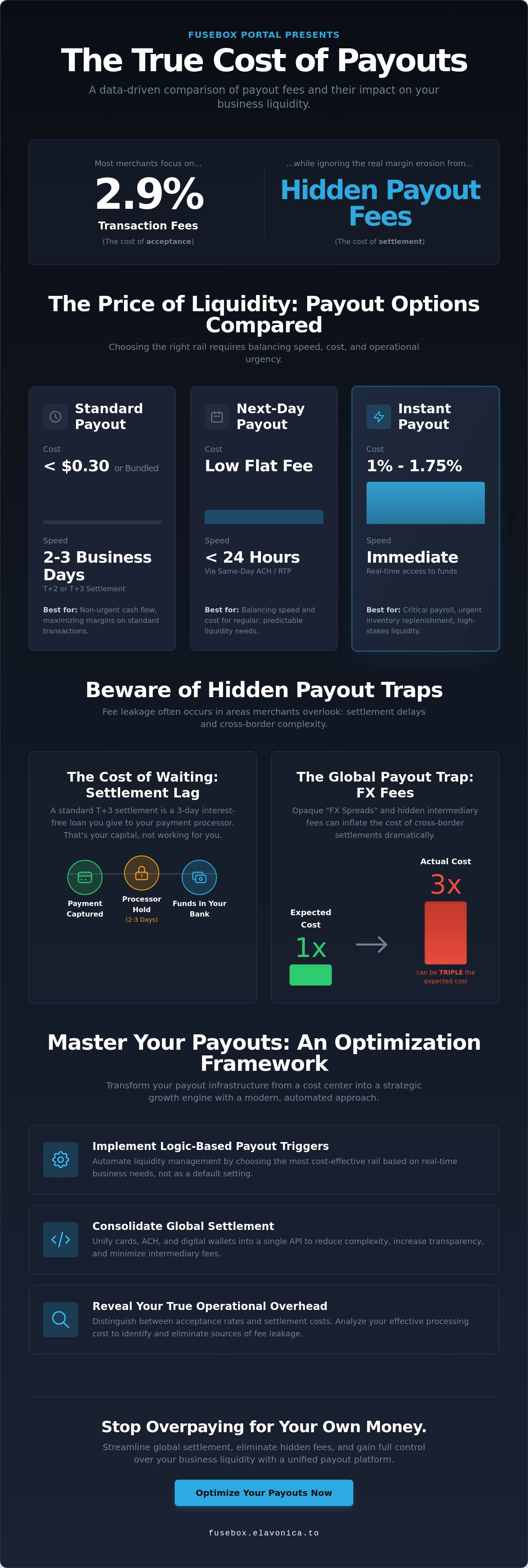
Acceptance is only half the battle. Most merchants obsess over the 2.9% transaction fee while ignoring the costs that follow. If you only look at the swipe, you're missing the margin. A strategic payout fees comparison must account for the entire lifecycle of a dollar, from the customer’s wallet to your business bank account. The settlement phase is where liquidity is either optimized or eroded.
In 2026, high-growth businesses treat payouts as a competitive lever. They don't just accept payments; they orchestrate them. This requires moving beyond the surface-level transaction rate and understanding the mechanics of settlement. The goal isn't just to process a sale. The goal is to move that capital into an accessible account as efficiently as possible. Speed is infrastructure.
Processing vs. Settlement: The Hidden Gap
The journey of a transaction is complex. When a customer pays, the funds are first authorized and captured. During this stage, various costs like interchange fees are calculated. These are the non-negotiable costs set by card networks. Processing fees cover this initial acceptance. However, the money isn't yours yet. It sits in a merchant account until settlement occurs.
Payout fees are distinct from processing fees. They represent the cost of moving your net earnings from the processor to your bank. Some providers bury these in a "net settlement" model. They deduct everything before you see the deposit. Others charge a flat fee per transfer. Standard payouts often seem free; they aren't. You're paying in time. A three-day settlement lag is a three-day interest-free loan you're giving to your processor. That's capital that isn't working for you. Don't ignore the gap.
The Liquidity Premium in 2026
Cash flow is the lifeblood of operations. In a volatile market, the value of immediate liquidity has skyrocketed. The shift toward real-time payments (RTP) has redefined merchant expectations. Waiting for T+2 or T+3 settlement cycles is no longer the industry standard; it's a bottleneck. Merchants now prioritize payout flexibility over low flat-rate transaction fees. They understand that a slightly higher processing fee is worth it if it unlocks instant access to capital.
Faster settlement allows for immediate inventory restocking and payroll fulfillment. It reduces the need for external business financing. Modern payout engines act as the final mile in the financial stack. They provide the logic to choose between instant, same-day, or standard rails based on current liquidity needs. If your stack doesn't offer this granularity, you're overpaying for your own money. Speed is a product. Liquidity is the benefit.
Instant vs. Standard Payout Fees: Calculating the Price of Liquidity
Speed is a capital expense. Choosing between instant and standard transfers requires a calculation of capital cost versus operational urgency. A detailed payout fees comparison shows that standard ACH transfers often cost less than $0.30 or are bundled at no extra charge, but they require a multi-day settlement window. Instant transfers eliminate this wait for a premium, typically ranging between 1% and 1.75% of the total amount. For enterprise-level merchants, these costs are often negotiated into volume-based schedules that align with total processing throughput.
Next-day payouts serve as the middle ground for balancing cost and speed. By utilizing same-day ACH or the RTP network, merchants can access funds within 24 hours for a fraction of the cost of a percentage-based instant transfer. In 2026, the strategic use of these different rails is what separates efficient operations from those suffering from fee leakage. It’s about choosing the right rail for the right transaction.
The Math of Instant Payouts
Paying a 1.5% fee for 48-hour faster access isn't just a convenience; it's a high-interest liquidity event. When annualized, this fee structure represents a significant cost of capital. This makes sense for critical payroll cycles or inventory replenishment but erodes margins if used as a default settlement method. Many major platforms cap these fees at $25 to $50 per transfer, making them more economical for high-value settlements over $2,000.
Understanding the Costs of Electronic Payments allows you to identify where these micro-fees impact your net profitability. You can optimize your settlement logic to route funds based on current cash requirements rather than a static schedule. This targeted approach preserves your margins while maintaining necessary cash flow for growth.
Standard Payouts and Batching Strategies
Standard timing thrives on predictability. Batching transfers into weekly or bi-weekly cycles reduces flat-fee overhead and simplifies accounting reconciliation for smaller merchants. However, in high-growth environments, T+2 timing can stall reinvestment. The emergence of the RTP network and FedNow provides a massive advantage here, offering settlement in seconds for as little as $0.01 to $0.05 per transaction. These networks now reach the majority of U.S. checking accounts. Aligning these rails with your accounting cycles ensures liquidity without the percentage-based tax of traditional instant transfers.
Global Payout Fee Comparison: Navigating Cross-Border Settlement
Crossing borders isn't just a logistical step. It's a margin killer. A thorough payout fees comparison reveals that international settlement often triples the cost of domestic transfers. While a domestic wire might cost between $15 and $50, an international transfer frequently jumps to $35 or $80 per transaction. These are just the base fees. Cross-border transactions typically add another 1.5% to the total, with an additional 1% tacked on for currency conversion. For high-volume merchants, these micro-percentages represent significant capital leakage.
Transparency is rare in global settlement. Most processors profit from the "FX Spread" trap. They offer a rate significantly lower than the mid-market exchange rate, pocketing the difference without a separate line item. Understanding the FTC rules on electronic payments provides a baseline for what merchants should expect regarding cost disclosures. However, these rules don't always protect you from intermediary bank fees. These "landing fees" are charged by banks within the SWIFT network that your processor doesn't control. They deduct their cut before the funds reach the destination bank. This is why unified payment processing is essential. It allows you to bypass the traditional SWIFT bottleneck by utilizing local payout rails.
Hidden Costs of International Transfers
The gap between the mid-market rate and the processor’s rate is your first invisible expense. If the market rate is 1.20 but your processor gives you 1.18, you've lost 1.6% before any fees are applied. Landing fees add another layer of unpredictability. A merchant might send $1,000 and the recipient only gets $975. The missing $25 was likely siphoned by an intermediary bank. A strategic payout fees comparison must account for these "lost" funds to determine the true cost of global operations. Localized settlement is the only way to eliminate these variables.
Regional Payout Standards
Europe leads in efficiency with SEPA Instant. It allows for low-cost, near-immediate settlement across the Eurozone. In North America, the landscape is shifting from standard ACH to Same-Day ACH, which costs between $0.05 and $0.30 per transaction. The RTP network now reaches 65% of U.S. checking accounts as of December 2025, offering $0.01 to $0.05 settlement costs. Asia-Pacific remains the most fragmented region. Success there requires navigating a mix of local bank transfers and digital wallets. Each region requires a specific rail to keep costs down and speed up. Don't use a global wire when a local transfer is available.
Optimization Framework: Reducing Payout Overhead through Automation
Efficiency isn't just about finding the lowest rate. It's about how you deploy your capital. This payout fees comparison has established that speed carries a premium, but manual oversight carries a hidden tax. High-growth merchants use automation to bridge the gap. By implementing logic-based triggers, you can dictate exactly when to use expensive instant rails and when to settle for lower-cost standard options. You shouldn't pay for instant liquidity unless your operational balance falls below a specific threshold. This is strategic capital management.
Scaling globally requires more than just a bank account. It requires a unified infrastructure. Using a single API to manage 100+ payment methods and global settlements eliminates the friction of multiple regional contracts. It centralizes your financial data into a single source of truth. This consolidation drastically reduces the soft costs of manual accounting. Manual reconciliation is a significant drain on resources, often leading to human error and delayed reporting. Automated settlement transforms hours of spreadsheet work into seconds of data processing. You gain real-time visibility into your cash flow without the administrative burden.
API-First Payout Strategies
A unified API provides a single point of entry for global markets. You don't need to build custom integrations for every new region or payment rail. API integration eliminates manual data entry and reduces payout errors by centralizing settlement logic. Webhook-based notifications deliver real-time reporting directly to your ledger. This ensures your internal systems always reflect your actual bank balance. It’s about building a stack that scales as fast as your sales. You can automate your payout infrastructure to ensure every dollar moves via the most efficient path possible.
Fraud Prevention and Payout Security
Security is the foundation of settlement. Payout freezes often stem from inadequate risk management. ML-powered fraud detection protects your payout balance by identifying high-risk transactions before they trigger a hold. Research indicates that 4% of high-growth merchants are affected by account freezes annually. This disruption is often avoidable with proactive risk screening. There's a direct relationship between your chargeback rates and your payout availability. Keeping these rates low ensures your funds remain accessible. Secure your infrastructure with multi-factor authentication and IP whitelisting to prevent unauthorized transfers. Protection isn't a feature; it's a requirement for consistent liquidity.
Unified Payouts with Elavon Fusebox: Streamlining Global Settlement
Consolidate your financial infrastructure to stop margin erosion. Elavon Fusebox provides a single, authoritative API for cards, ACH, digital wallets, and global payouts. A comprehensive payout fees comparison reveals that most scaling brands suffer from "fee stacking" when they manage multiple regional gateway contracts. Each redundant contract introduces separate acceptance, settlement, and compliance costs that fragment your data. We eliminate this complexity. Our unified platform routes every transaction through the most cost-effective path regardless of geography. You receive transparent pricing with no hidden FX spreads or surprise intermediary fees. This is a 360-degree view of your cash flow that legacy processors cannot provide.
Unbiased routing serves as the core of our settlement efficiency. We analyze the cost, speed, and reliability of available rails in real-time to ensure your capital moves via the most efficient route. If a local transfer is more economical than a global wire, our system selects that path automatically. This isn't just a convenience; it's a financial engine built to protect your bottom line from the "FX Spread" traps and SWIFT bottlenecks identified earlier. Traditional processors often route funds through their own high-margin networks. We route them through the path that favors your business liquidity. You gain instant payouts to bank accounts worldwide via a secure, independent platform.
The Elavon Fusebox Advantage: Independence and Speed
Independence ensures our routing logic remains focused on your margins. We don't prioritize specific banking partners; we prioritize your cost of capital. Lower fees are the direct result of this technological freedom. By integrating 100+ payment methods into a single dashboard, we remove the friction of global expansion. Our RESTful API is built for high-performance environments. You can reduce developer overhead and deploy global settlement capabilities in days rather than months. It’s about building a robust infrastructure without the weight of legacy jargon or opaque fee schedules. One API delivers total control over your settlement lifecycle.
Getting Started with Optimized Payouts
Transitioning to an optimized payout model is methodical and fast. You can set up the Elavon Fusebox reporting and reconciliation dashboard in under 5 minutes. This immediate visibility allows you to move away from legacy processors that obscure costs behind complex reports. Our integrated invoicing bridges the gap between customer acceptance and merchant settlement. You no longer need to manually match bank deposits to invoices. The portal handles reconciliation automatically, providing a real-time audit trail for every transaction. This reduces the soft cost of manual accounting and ensures your books stay clean during high-volume periods. Ready to optimize your payouts? Get started with Elavon Fusebox today.
Future-Proof Your Global Settlement Strategy
Liquidity is the engine of high-growth commerce. This payout fees comparison demonstrates that settlement is a strategic liquidity product rather than a simple administrative task. You've identified how to distinguish between processing and settlement costs while navigating the high-stakes world of international FX. Speed shouldn't come at the cost of your margin. By implementing logic-based automation and utilizing local payout rails, you eliminate fee leakage and manual reconciliation errors.
Infrastructure must scale with your ambition. A unified payout engine provides the transparency and control required to manage complex global settlements with precision. Protect your capital with integrated security and streamlined reporting. You have the framework to transform your financial stack into a silent, powerful growth engine. It's time to reclaim your margins and optimize your cash flow.
Optimize your global payouts with Elavon Fusebox to access instant payouts to bank accounts worldwide. Our unified API manages 100+ payment methods and includes ML-powered fraud detection as standard. Secure your liquidity and start scaling today.
Frequently Asked Questions
What is the difference between a processing fee and a payout fee?
Processing fees cover the cost of authorizing and capturing a customer's payment at the point of sale. Payout fees are the distinct costs associated with moving those net funds from your merchant account to your business bank account. It's the final stage of the transaction lifecycle where liquidity is settled.
How much does an instant payout typically cost for a merchant?
Instant payouts typically cost between 1% and 1.75% of the total transfer amount. For instance, charges can range from 1.5% to 1.75% depending on the service provider. A detailed payout fees comparison shows that these percentage-based costs are significantly higher than the flat fees associated with standard ACH or RTP transfers.
Are there hidden fees in international bank payouts?
Yes, international payouts often involve hidden FX spreads and intermediary bank charges. Processors may provide an exchange rate significantly below the mid-market rate while pocketing the difference. Intermediary banks within the SWIFT network can also deduct landing fees before the funds reach your destination account, leading to unpredictable settlement totals.
Can I receive payouts in different currencies to avoid FX fees?
Many modern platforms allow you to settle and hold funds in the original transaction currency to bypass immediate conversion. This strategy avoids expensive FX spreads during the payout process. You can then move these funds using local settlement rails or wait for more favorable market conditions before converting them to your primary currency.
How does an API-based payout system save money compared to manual transfers?
API-based systems save money by automating reconciliation and implementing logic-based routing. You can program your infrastructure to automatically select the most cost-effective rail based on the transfer amount and destination. Automation eliminates the soft costs of manual data entry and prevents expensive human errors during global settlement.
What is the standard payout time for most online payment gateways?
The standard payout time for most online payment gateways is T+2 or T+3 business days. This delay allows processors to manage risk and verify transactions before releasing funds. While standard settlement is often the least expensive option, it creates a settlement lag that can impact your operational cash flow.
Do payout fees vary depending on the payment method used?
Yes, payout fees vary significantly based on the underlying network used for the transfer. ACH transfers and RTP network settlements usually incur low flat fees per transaction. In contrast, instant transfers that utilize card networks are almost always percentage-based, making them the most expensive method for accessing capital.
How can I reduce the cost of instant payouts for my business?
You can reduce costs by implementing balance thresholds that only trigger instant payouts when liquidity is critically low. Transitioning from legacy card-based instant transfers to real-time networks like RTP or FedNow can also lower overhead. These modern networks offer near-instant settlement for a fraction of the cost of traditional percentage-based fees.